
What does it mean to come home after the world has changed you? Homer’s Odyssey asks the question through storms, monsters, gods and a king who takes ten years to return to Ithaca. Joseph Campbell saw in that voyage more than an adventure story. He treated it as one of the enduring images of the hero’s journey: departure from the familiar, transformation through ordeal, and a difficult return carrying new knowledge.
Joseph Campbell was an American writer, teacher and comparative mythologist who taught literature at Sarah Lawrence College from 1934 to 1972. He did not leave a clinical “psychoanalysis” of Odysseus. Instead, he offered a mythological and psychological reading. His 1971 Sarah Lawrence lecture, preserved by the Joseph Campbell Foundation, traces Odysseus’ adventures through symbolic patterns and describes the poem as a “tenderizing” of the hero. It stops before Odysseus’ final return to Ithaca: Campbell says he will discuss Telemachus and the suitors in the next class.1 2
This guide follows Campbell’s lens without pretending that every interpretation below is a direct quotation from him. It also asks where the famous “hero’s journey” clarifies Homer—and where it can flatten the poem’s particular history, ethics and community.
In brief: For Campbell, the Odyssey is a story of separation, initiation and return. Odysseus leaves the world he knew, faces forces that test his identity, and comes back to Ithaca changed. Read psychologically, homecoming is not simply reaching an island; it is the hard work of becoming capable of living again among other people.
Who was Joseph Campbell—and why did he read myths psychologically?
Joseph Campbell (1904–1987) was an American author and teacher whose work compared myths and religions across cultures. He studied English and medieval literature at Columbia, continued his studies in Paris and Munich, and later became a professor of literature at Sarah Lawrence. There he taught mythology for nearly four decades.3 4
Campbell was influenced by the psychology of Sigmund Freud and Carl Jung, as well as the comparative mythologist Heinrich Zimmer. The Joseph Campbell Foundation describes his central idea as the view that myths share patterns rooted in the human psyche. That is Campbell’s interpretive position, not a settled scientific finding that every culture tells the same story.3 4
His best-known book, The Hero with a Thousand Faces (1949), proposed what Campbell called the monomyth—a recurring pattern in heroic stories. He summarised its broad movement as separation, initiation and return. The hero leaves ordinary life, passes through a changed or unfamiliar world, undergoes a decisive ordeal and returns with something that can renew life at home. Campbell explicitly named Ulysses’ long voyage home after the Trojan War as one example of this cycle.2
“Hero’s journey” is now the common label, but Campbell’s book used terms such as “hero-quest” and “monomyth.” The distinction matters: Campbell did not intend a screenwriting checklist with fixed beats. His own description allows for variation. One story may emphasise the departure; another may spend most of its time in the realm of ordeal; the return may be refused, delayed or incomplete.2
The Odyssey is already a story about return
Homer’s poem begins not with Odysseus setting sail from Troy but in the middle of the larger story. In Ithaca, Penelope and Telemachus face the suitors. Odysseus is missing, and the audience gradually learns what happened through the hero’s account of his travels. The poem’s structure therefore makes the return a question before it makes it a destination.5
The Greek idea of nostos means homecoming. Odysseus’ task is not only to cross the sea; he must recover his place in a household and kingdom altered by his absence. The poem also examines xenia, the obligations of hospitality between host and guest, along with loyalty, identity, restraint and the consequences of violence. These are specific themes in Homer’s poem, not merely symbols for an individual’s inner life.5
Campbell’s psychological reading adds another level. Ithaca can be read as the familiar world of identity and belonging. The sea becomes the uncertain territory of change. The monsters and temptations dramatise dangers to survival, memory and self-command. But this is a reading through Campbell’s lens—not proof that Homer intended each episode as a coded stage of modern psychotherapy.
Odysseus’ journey through Campbell’s three movements
1. Separation: leaving the known world
In Campbell’s model, a hero’s adventure begins when ordinary life is disrupted and the familiar world can no longer contain the story. Odysseus’ departure for Troy lies before the main voyage of the Odyssey, but the return journey begins under the shadow of that earlier separation. The war has ended. The homecoming should follow. Instead, Odysseus remains at sea, unable to return to his family and rule.2 5
Psychologically, the first question is not “Where is Ithaca?” but “Who can return?” Odysseus has been a king, commander, husband and father. His travels test whether those identities survive outside their home setting. The poem makes the separation collective at first: Odysseus sails with companions. Their losses progressively narrow the story until he is the only survivor. A Campbellian reading sees a movement from social identity toward an encounter the hero must face alone.
That does not mean Odysseus is simply a modern individual “finding himself.” He remains bound by family, status, divine relationships and obligations to his crew. Campbell’s model highlights personal transformation; Homer’s poem keeps the social world in view.
2. Initiation: ordeal, temptation and the knowledge of limits
Campbell’s initiation stage is not a smooth sequence of level-ups. It is a passage through tests, helpers, threats and a central ordeal that changes what the hero knows. Odysseus’ encounters give the model vivid examples, even if the poem itself does not label them as psychological exercises.
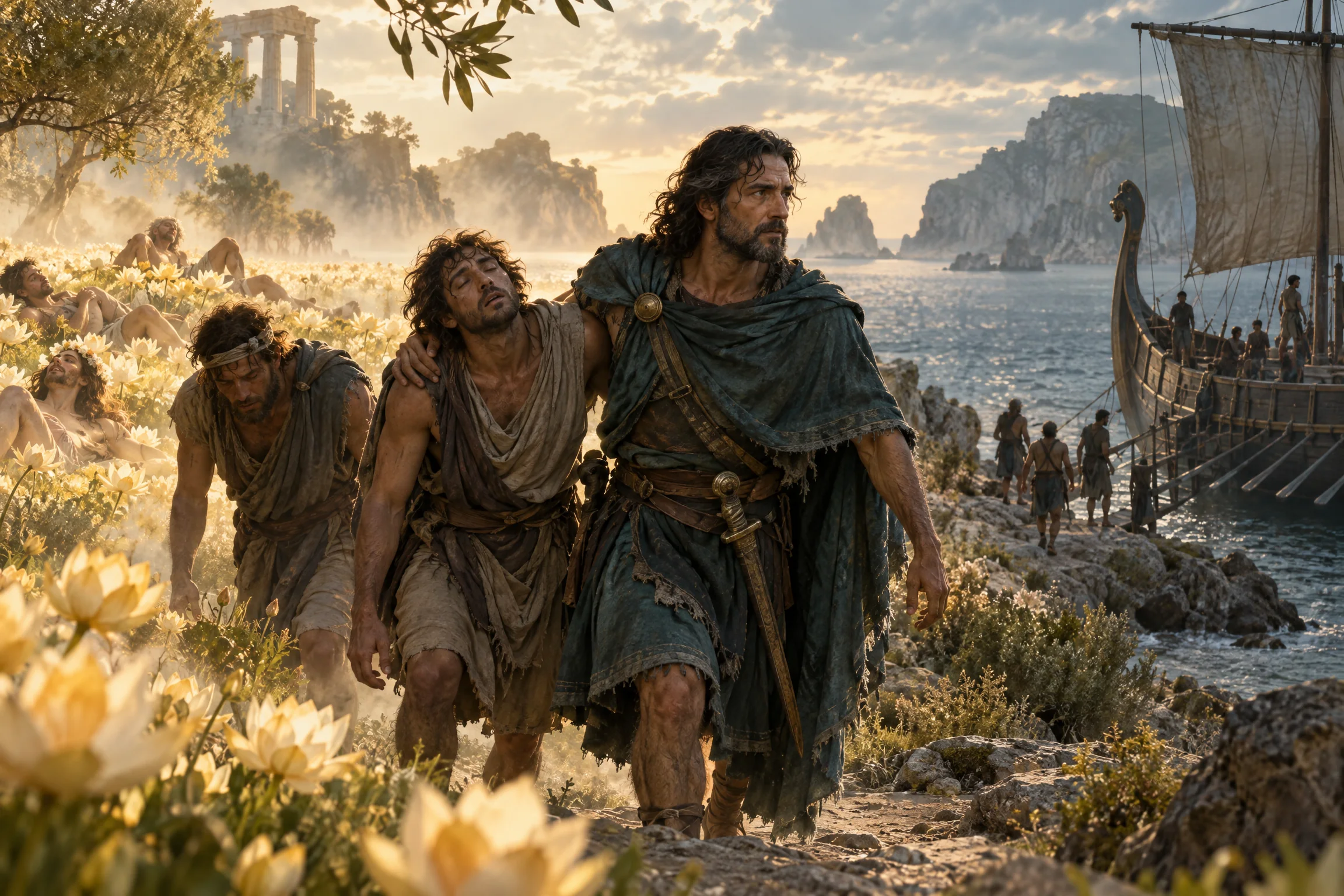
The first threshold is the land of the Lotus-Eaters. Some of Odysseus’ men taste the lotus and lose the desire to return. Campbell reads the episode as entry into a mythic realm where ordinary duties and memory can fall away. Psychologically, it poses an unsettling question: what if comfort makes us forget what we set out to do?1 5
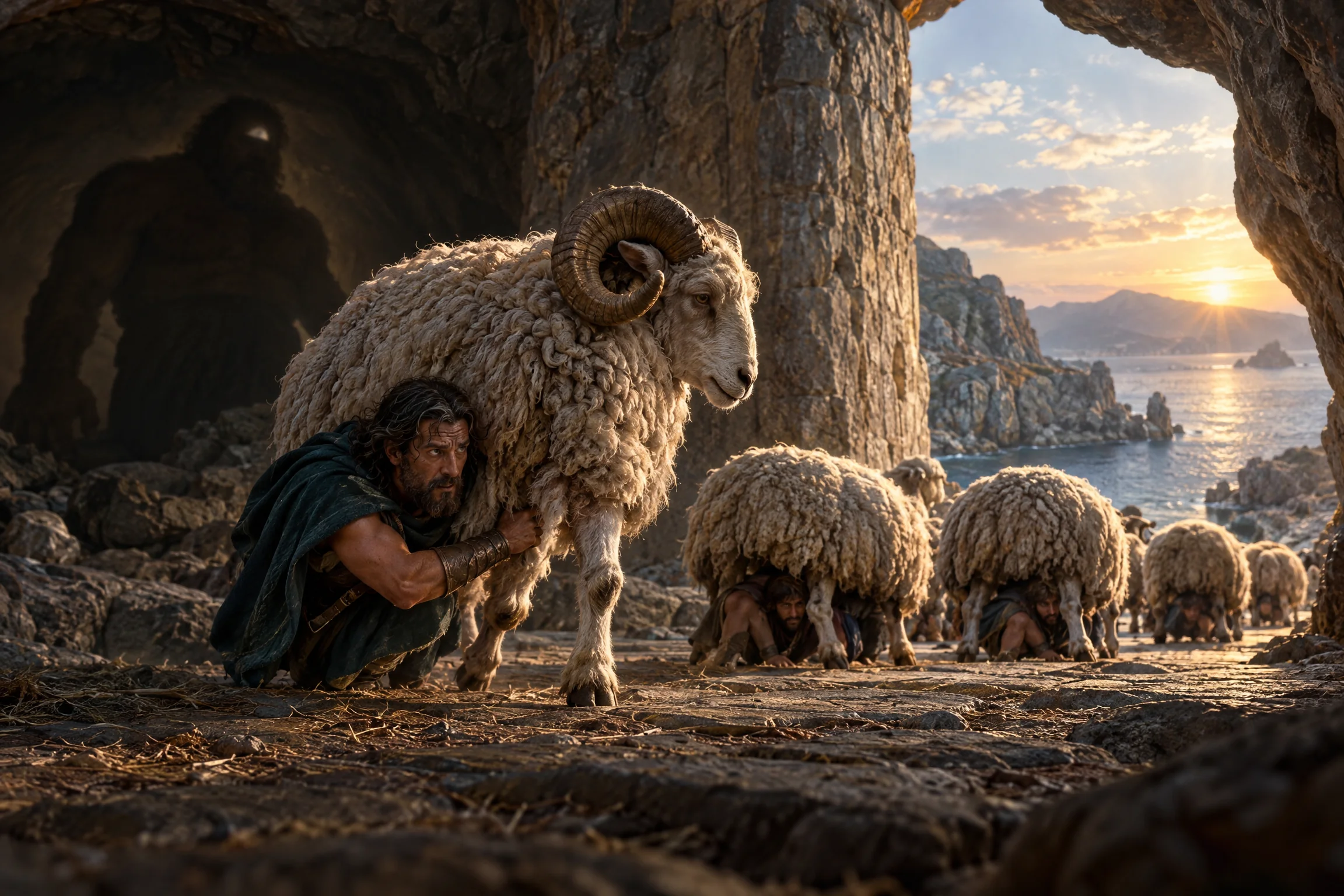
The Cyclops is Campbell’s threshold guardian. Odysseus escapes Polyphemus by hiding beneath the rams, then calls himself “Noman” when asked his name. Campbell reads the disguise as a temporary release from social identity and duty. But Odysseus’ later boast reveals the cost of pride: he gives Poseidon the name needed to pursue him. Cleverness saves the crew in the cave; self-control might have prevented the next danger.1 5
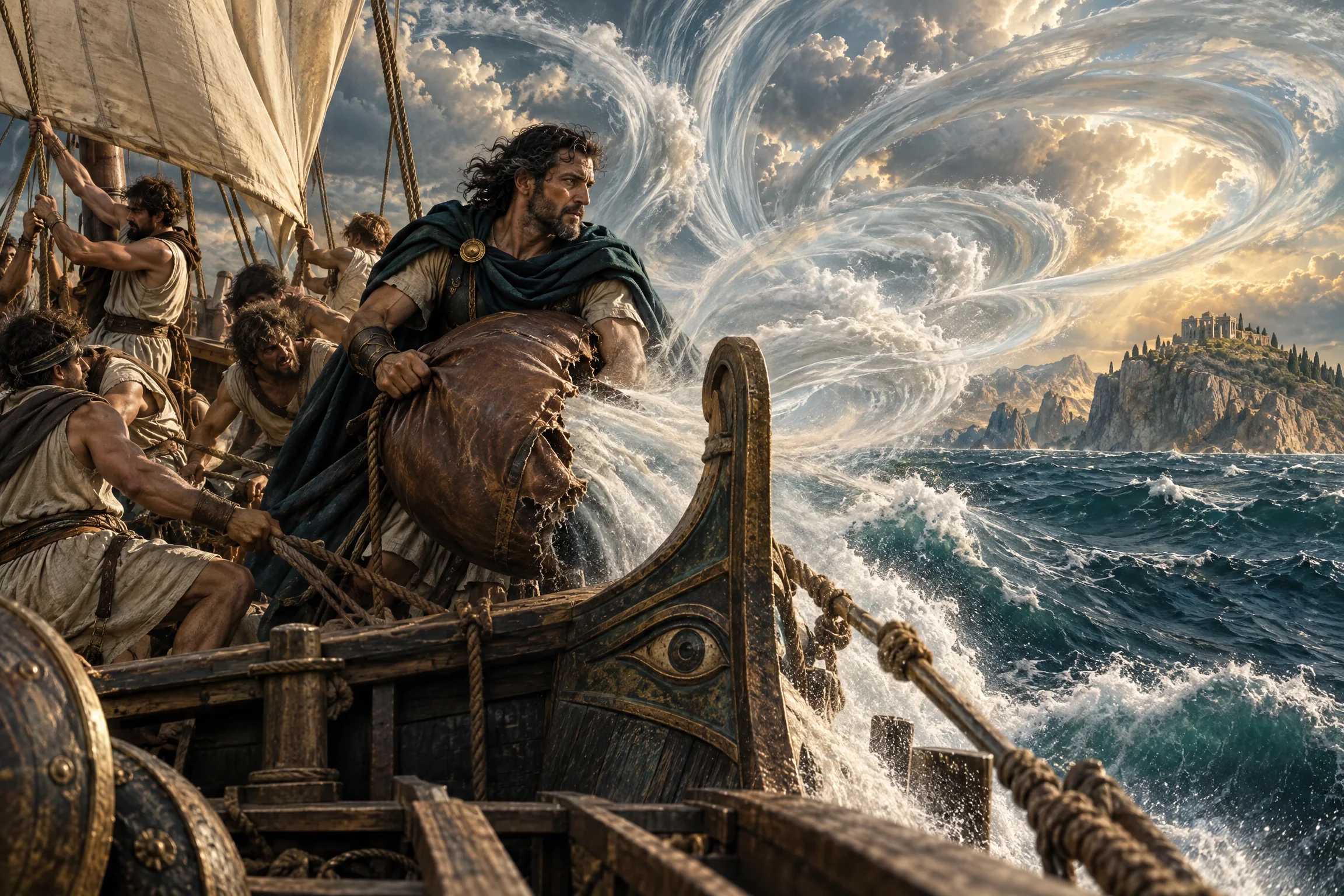
After the cave, Aeolus gives Odysseus a bag of winds. Campbell interprets the winds as divine breath and the crew’s curiosity as a failure to control the force they have been given. The Laestrygonians then destroy all but one of the ships. Campbell reads the shrinking fleet as a progressive stripping-away of the hero’s former power and protection.1

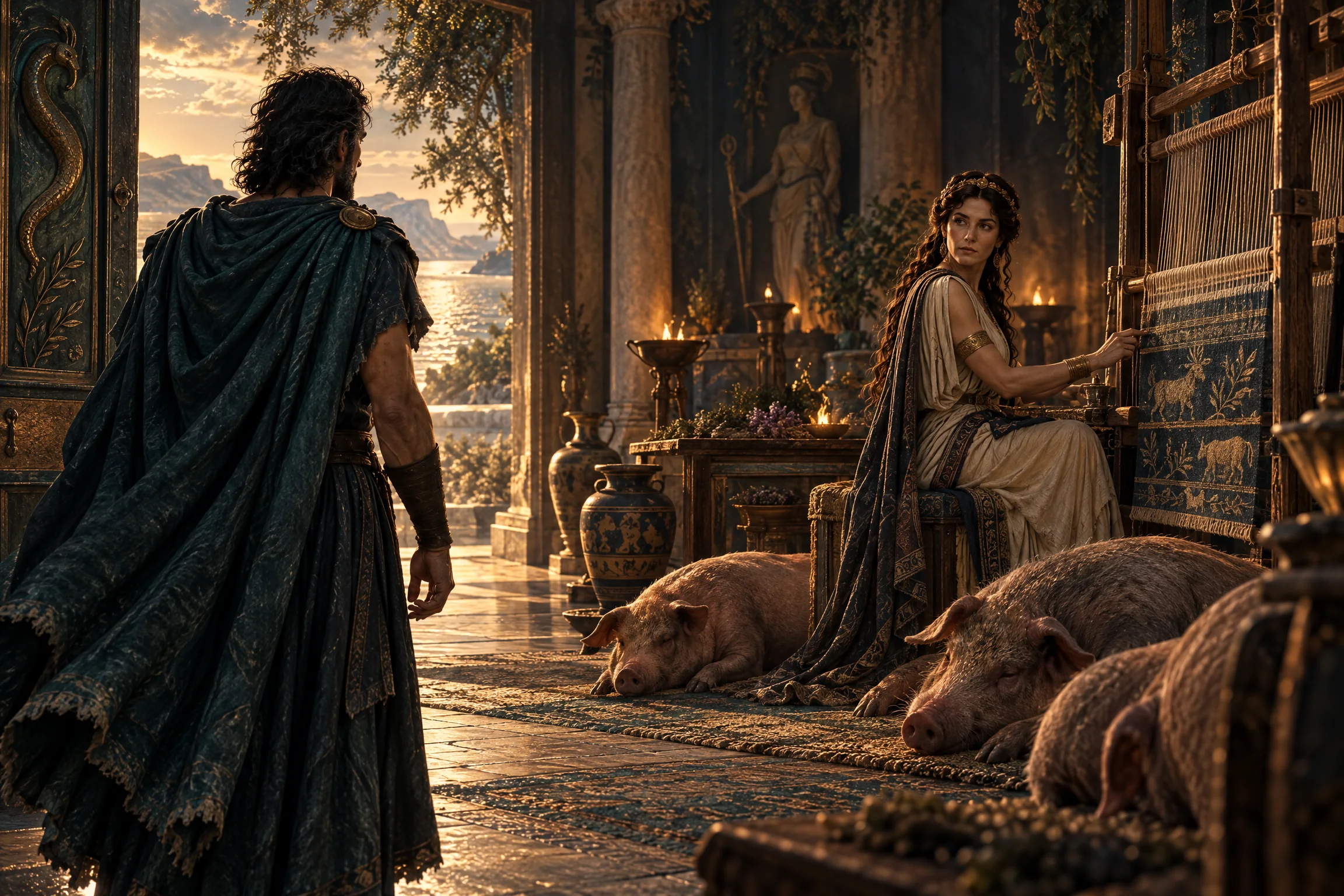
Circe’s island adds a different kind of test. Odysseus must negotiate danger, desire and the fate of his men. In his lecture, Campbell reads Circe’s weaving as a sign of a creator-goddess and has her guide Odysseus toward the ancestors in the underworld. Those are Campbell’s comparative-mythology associations, not proof that Homer intended a hidden psychological code.1 5
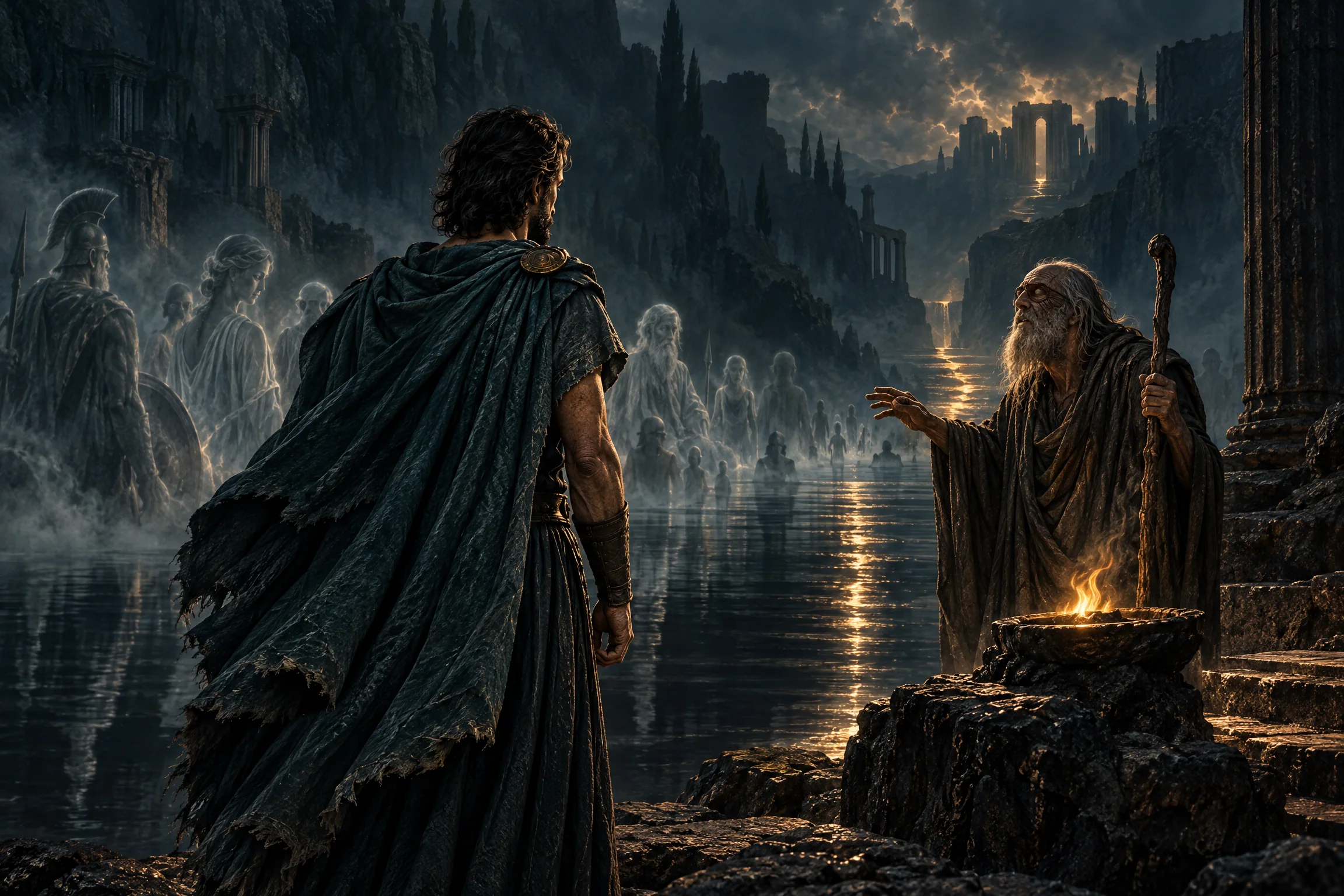
The descent to the underworld is the journey’s clearest symbolic confrontation with death and knowledge. Odysseus seeks Tiresias’ prophecy and meets the dead, including his mother. A psychological reading might call this an encounter with what ordinary life keeps outside awareness: mortality, grief, inherited history and the limits of control. Campbell’s framework often understands such a descent as a symbolic death before renewed life. That is an interpretive analogy, not a claim that Homer was practising Jungian psychology centuries before Jung existed.
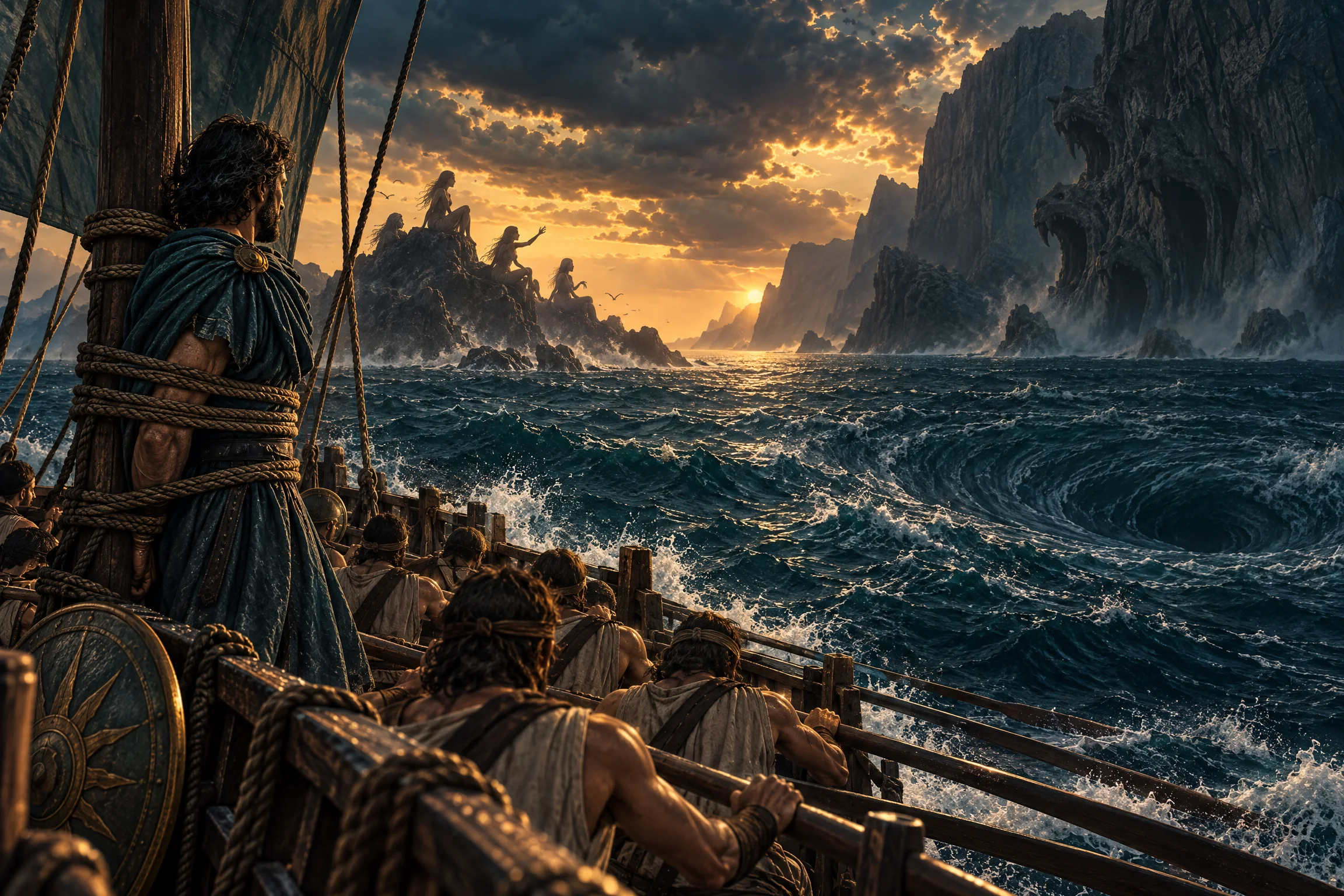
The Sirens, Scylla and Charybdis continue the test of judgement. Campbell reads the Sirens as the lure of worldly pleasure and Scylla and Charybdis as opposing extremes. Odysseus cannot make every danger disappear; sometimes the task is to hold course between them. The cattle of Helios bring the crew’s choices to a breaking point. When they kill the sacred animals, their ship is destroyed, and Odysseus is left alone. Campbell reads this catastrophe as near-total divestiture, followed by a choice between leaving the world behind and returning to it. Odysseus chooses to come back.1 5
After the shipwreck, Odysseus reaches Calypso’s island before setting out again. Campbell describes this stay as a period of absorbing what he has learned about marriage and human relationships. Read more broadly, Calypso’s offer of immortality sharpens the poem’s central tension: an eternal refuge cannot replace the finite home Odysseus still longs for.1 5

3. Return: identity must be recognised at home
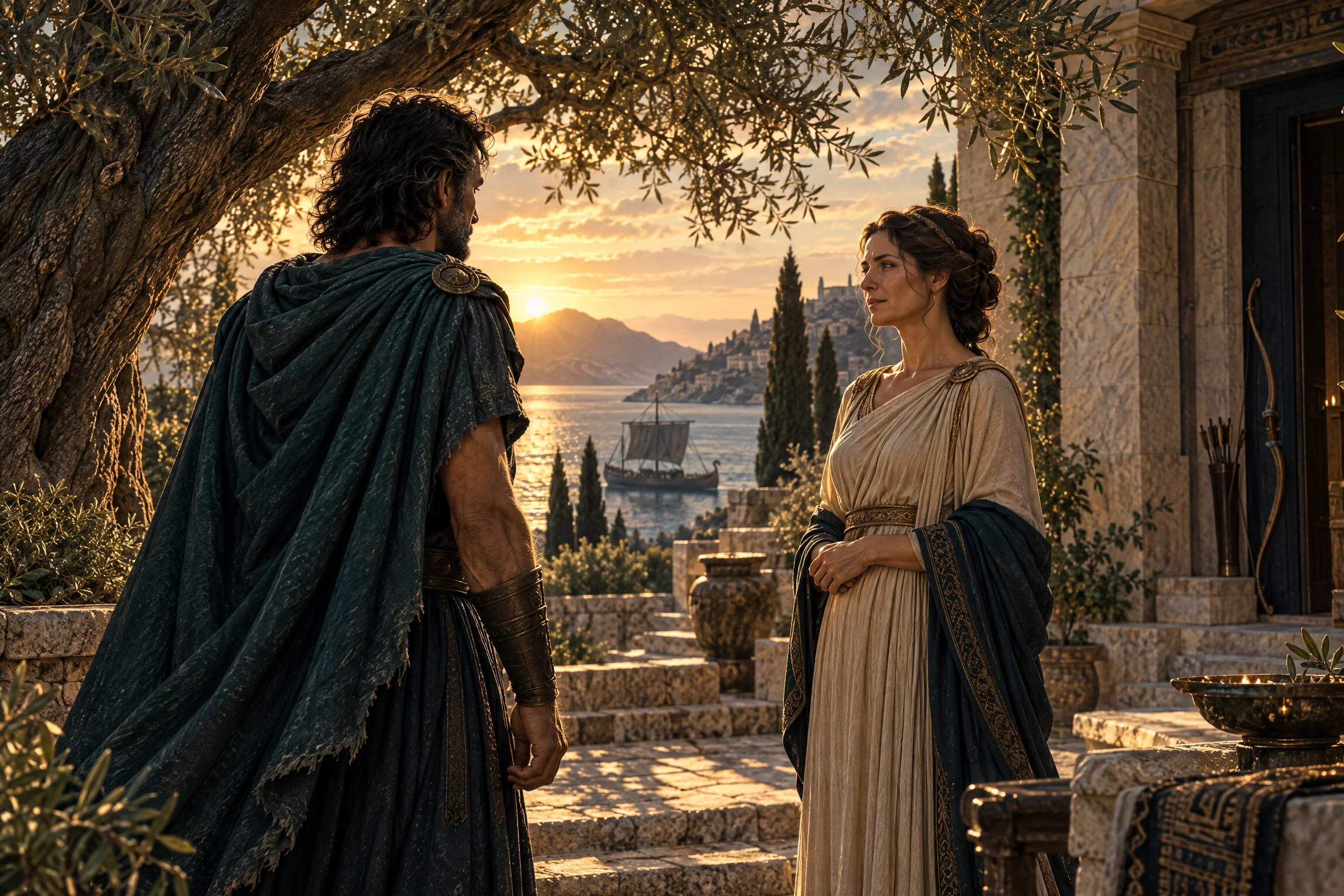
Odysseus reaches Ithaca, but physical arrival is not the same as restored belonging. He returns disguised. Before the household can recognise him, he must observe it, test loyalties and reveal himself in stages. The bow contest, Telemachus’ recognition and Penelope’s test of the marriage bed turn homecoming into a question of identity: how can the person who left prove that he is still the person who belongs?5
Campbell’s return stage asks whether the hero can cross back from the extraordinary world and bring something of value into ordinary life. In Homer, the “boon” is not a magic object or a simple moral lesson. It is the recovery of Odysseus’ household and kingship, and the re-establishment of order in Ithaca. The return is also violent: Odysseus and his allies kill the suitors. The restoration is not uncomplicated, and later Greek tradition continues beyond the poem’s ending.
The psychological insight is therefore more demanding than “follow your bliss” or “become your true self.” Odysseus must re-enter relationships and a political community. His identity is not completed in isolation. It is tested and recognised by people who knew him before the voyage.
What Campbell himself said in his 1971 lecture
Campbell’s recorded lecture offers a more specific interpretation than the familiar three-part summary. He begins with Odysseus’ violence at Ismarus after Troy and calls the Odyssey a process of “tenderizing”: a once-dominant warrior is forced to yield to powers beyond his control. He identifies the Lotus-Eaters as the threshold into the mythic realm. The Cyclops is a threshold guardian, and Odysseus’ self-identification as “Noman” signals, in Campbell’s reading, a temporary release from his earthly social identity and duties.1
Campbell then interprets the wind-bag of Aeolus as divine breath that Odysseus’ crew cannot control, the Laestrygonians’ destruction of most of the fleet as a stripping-away, and Circe as a creator-goddess who guides Odysseus toward the ancestors in the underworld. He reads Tiresias through a symbolic union of male and female principles, the Sirens as the lure of worldly pleasure, and Scylla and Charybdis as opposing extremes. These are Campbell’s own symbolic associations, not a consensus account of what Homer intended.1
His lecture also gives the poem a speculative astronomical layer. Campbell proposes that Penelope’s weaving may echo the moon, casts Odysseus as a solar figure, and links their twenty-year separation and the twelve axes of the bow contest to celestial cycles. Treat these as Campbell’s comparative-mythology hypotheses—not established facts about Homer or ancient Greek astronomy. His language about male and female principles is also rooted in a dated binary framework. Readers can examine it critically rather than accepting it as a timeless account of gender.1
One boundary is especially important: this particular lecture ends with Odysseus on the Phaeacians’ ship, asleep on his way home. Campbell says the next class will take up Telemachus and the slaying of the suitors. The Ithaca material below therefore combines Homer’s plot with Campbell’s general account of the hero’s return; it should not be presented as a detailed conclusion from this surviving 1971 lecture.1 2 The broader three-part frame—separation, initiation and return—comes from The Hero with a Thousand Faces, where Campbell names Ulysses’ voyage home as an example.2
What the monsters can mean—and what they cannot prove
A psychological reading treats mythic figures as images that can help people think about inner conflict. The Cyclops may invite reflection on force without social restraint. The Sirens can represent knowledge or pleasure so absorbing that it endangers a person’s chosen purpose. The underworld makes grief and mortality impossible to ignore. These readings can be illuminating, but they are not the only meanings in the poem, and Campbell should not be used to present them as Homer’s documented intention.
Homer’s monsters also belong to a narrative world of divine power, oral performance and Greek social values. They are not simply “parts of the psyche.” The Cyclops violates hospitality; the Sirens test a traveller; the gods act as gods in the poem’s religious imagination. The difference between these explanations matters. Psychology can add a layer of meaning without cancelling the poem’s ancient setting.
What Campbell’s hero’s journey gets right—and what it leaves out
Campbell’s enduring contribution is a compelling account of why departure, trial and return recur in stories. His framework helps readers see that Odysseus’ trip is not a collection of unrelated adventures. The episodes repeatedly ask whether the hero can preserve memory, judgement and purpose while the familiar world falls away. The eventual return matters because transformation without return would leave the household and community outside the story.2
But the monomyth has serious limits. Critics argue that Campbell’s universal pattern can smooth over cultural differences and overemphasise the solitary male hero. A 2024 scholarly introduction to critiques of the Hero’s Journey calls for more narrative plurality, including stories built around community, companionship and collective experience.6 The Odyssey itself challenges a simplified hero myth: Odysseus’ choices have consequences for his crew, Penelope, Telemachus, enslaved women and suitors. His return includes mass killing and the execution of enslaved women, not a frictionless moral triumph.8
The poem is also not only Odysseus’ story. Telemachus undertakes his own coming-of-age journey in the opening books. Penelope’s intelligence and patience shape the homecoming. Athena’s involvement, the suitors’ abuse of hospitality and the household’s political future all matter. Reading every character as a helper, obstacle or symbol in one man’s self-development would miss the richness of Homer’s design.
A careful conclusion is not that Campbell was right or wrong in every detail. His framework is a powerful lens, but a lens is not the whole poem. Use it to ask what the journey does to Odysseus. Then widen the frame to ask what his return costs, whom it restores and whose voices the hero’s story leaves at the margins.
Joseph Campbell and Christopher Nolan’s The Odyssey
Christopher Nolan’s 2026 film adaptation gives contemporary viewers another layer to consider. The Joseph Campbell Foundation’s 2026 essay on the film is by Bradley Olson, PhD—not Campbell, who died in 1987. Olson reads Nolan’s version as a modern, psychologically haunted reworking of the ancient poem, paying particular attention to trauma, the gods, Sinon and the ending. These are Olson’s interpretations of Nolan’s film, not Campbell’s own comments about a movie made decades after his death.7
That distinction makes the comparison more interesting. Campbell gives us a vocabulary for departure, ordeal and return. Olson applies a related myth-and-psychology framework to Nolan’s adaptation. Homer remains the source text, Campbell the earlier interpreter, and the 2026 film a new retelling. Each speaks to the others, but none should be mistaken for another.
For film details, editions and FilmHaven’s visual journal, explore the main FilmHaven site. Readers interested in Nolan’s adaptation can also visit The Odyssey film and editions page and browse the Spartan Victory collectible. Product availability and specifications can change; use the live product pages for current information.
Frequently asked questions
Who was Joseph Campbell, and where did he teach?
Joseph Campbell (1904–1987) was an American author and teacher known for comparative mythology. He taught literature and mythology at Sarah Lawrence College from 1934 until 1972.3 4
What did Joseph Campbell say about Homer’s Odyssey?
Campbell used Odysseus’ long voyage home as an example of the hero-quest or monomyth. His broad pattern is separation, initiation and return. In the 1971 lecture he describes the voyage as a “tenderizing” of Odysseus, reads the Lotus-Eaters as a threshold and the Cyclops as a threshold guardian, and proposes solar-lunar symbolism around Penelope and the bow contest. Those symbolic associations are Campbell’s interpretations, not scholarly consensus. The archived lecture stops before Odysseus reaches Ithaca; Campbell says he will discuss Telemachus and the suitors in the next class.1 2
What is the psychological meaning of Odysseus’ journey?
Through a Campbellian lens, the voyage can be read as a passage through disruption, ordeal and transformation before a return to relationships and community. This is an interpretive reading; Homer’s poem also concerns hospitality, divine power, loyalty, identity and the restoration of a household.5
Is the Odyssey a perfect example of the hero’s journey?
It is one of Campbell’s named examples, but no ancient poem fits a modern formula perfectly. The Odyssey’s non-linear structure, parallel story of Telemachus, role of Penelope and morally difficult homecoming complicate a simple three-stage summary.2 5
What does the underworld episode mean in Campbell’s framework?
Campbell often treats descent and ordeal as symbolic encounters with death, transformation and knowledge. In the Odyssey, Odysseus visits the dead to seek Tiresias’ counsel. A psychological reading can connect the episode with mortality and grief, but that connection should be described as an interpretation rather than Homer’s proven intention.2 5
Did Joseph Campbell analyse Christopher Nolan’s 2026 film?
No. Campbell died in 1987. The 2026 Joseph Campbell Foundation essay about Nolan’s film was written by Bradley Olson, PhD, and should not be attributed to Campbell.7
Is Joseph Campbell’s monomyth accepted as universal fact?
No. It is an influential interpretive model, not a settled law of storytelling. Critics argue that it can overgeneralise across cultures and privilege the solitary hero over community-based narratives.6
Where can I learn more about Nolan’s The Odyssey?
Visit the main FilmHaven site for the film’s visual journal and editions. The live product pages contain current details about the editions and related collectibles.
Explore the story beyond the page
Homer’s Odyssey can be read as an adventure, a poem about homecoming, a study of hospitality, or—through Joseph Campbell’s framework—a story of separation, ordeal and return. None of those readings exhausts it. That is why the poem continues to travel: each retelling changes the questions while keeping the journey recognisable.
Continue with FilmHaven’s The Odyssey film and editions, explore the full FilmHaven Journal and visual collection, or see the Spartan Victory 500 Series. This editorial page is independent and is not affiliated with or endorsed by Joseph Campbell Foundation, Universal Pictures, Syncopy or Christopher Nolan.
References
- Joseph Campbell Foundation, Pathways EP 41: The Odyssey
- Joseph Campbell Foundation, Joseph Campbell and the Hero’s Journey
- Encyclopaedia Britannica, Joseph Campbell
- Joseph Campbell Foundation, Biography of Joseph Campbell
- Encyclopaedia Britannica, Odyssey
- Roy Hanney, A Critical Examination of Joseph Campbell’s Hero’s Journey (2024)
- Bradley Olson, The Sedimented Hero: How Christopher Nolan’s The Odyssey Reimagines Myth for a Secular Age
- Los Angeles Review of Books, The Man Behind the Myth: Should We Question the Hero’s Journey?